Streamlining Maritime PMS Data Migration: A Comprehensive BASSnet Guide
“If a company neglects the migration of historical data, it risks losing out on valuable insights and operational efficiency…” (Forbes)
It’s never been a better time to upgrade to a modern cloud ERP system such as BASSnet. But when making the upgrade, it’s not enough to consider how advanced your new fleet management system is. What about the quality of your Planned Maintenance System (‘PMS’) data migration?
Every maintenance job, spare part, and inspection record tells a story that ensures your ships stay safe, compliant, and efficient. However, migrating that PMS data from legacy systems or third-party platforms into a new environment can be daunting.
It’s important to select a proven maritime PMS data migration and database management service provider (such as BASSnet’s) for seamless project success.
Why Maritime PMS Data Migration is a Strategic Necessity
Your data isn’t just information; it’s the history and heartbeat of your vessels. From maintenance to procurement, crewing, safety, and inventory management, every module in your maritime ERP system depends on accurate, consistent data.
Reliable ship PMS data is the foundation for fleet operational excellence, security and compliance.
This is why maritime PMS data migration is far more than a backend technical task—it’s a strategic enabler, ensuring faster adoption of your ERP system.
When done right, migration unlocks benefits like:
- Improved efficiency and decision-making, with clean and structured data that eliminates workflow friction.
- Reduced maintenance and infrastructure costs through database consolidation and modernisation.
- Scalability and security, particularly with cloud-enabled ERP systems.
For these reasons, BASSnet doesn’t treat migration as a one-off exercise. We consider it the foundation of a successful maritime cloud ERP transformation.
Challenges in Maritime PMS Data Migration
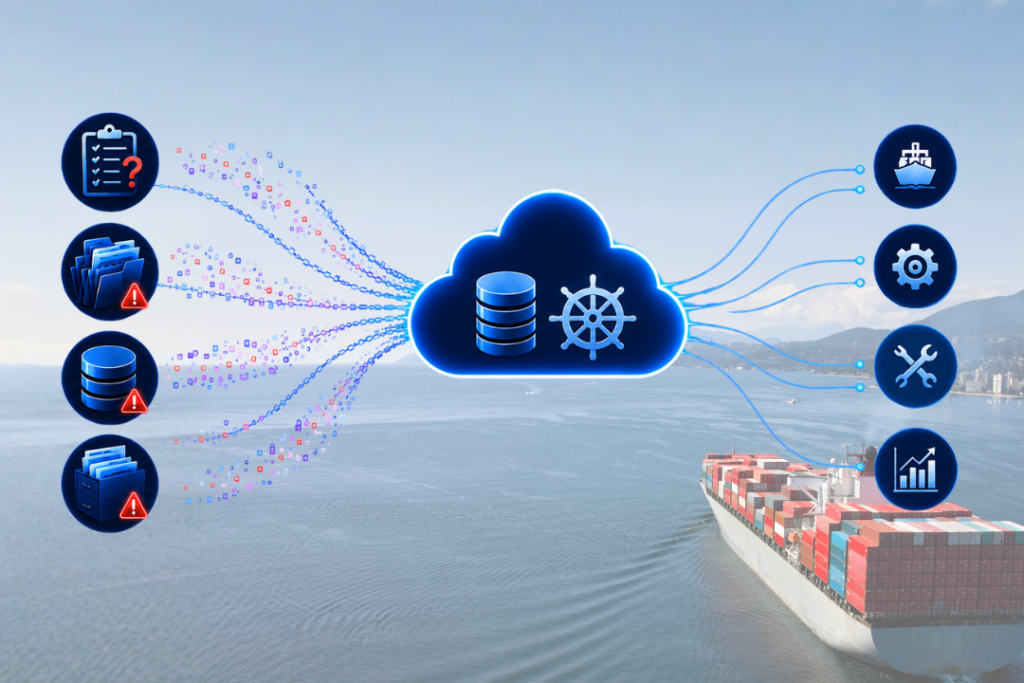
“On average, large IT projects run 45 percent over budget and 7 percent over time, while delivering 56 percent less value than predicted.” (McKinsey)
Migrating vessel data is no small feat. Many ship operators face hurdles such as:
- Inconsistent equipment naming conventions across fleets.
- Outdated or duplicate records.
- Missing job histories or incomplete maintenance hierarchies.
- Legacy database formats that don’t align with modern ERP structures.
The stakes are high: Gartner estimates 80–83% of data migration projects either fail or exceed their budget or schedule, according to both the Bloor Group and Gartner (Put Your Data First or Your Migration Will Come Last, Oracle and LumenData).
This reflects the high risk of schedule and budget overruns rather than only total technical failure.
Maritime PMS data migration in particular usually involves the entire fleet, which means the historical and operational data for each individual vessel must be addressed. Without a structured approach, you risk incomplete records, data mismatches, and operational disruption.
This is why it’s imperative to work with a maritime cloud software partner whose experienced team of experts understands shipping-specific challenges and risks—and tackles them through a structured, transparent, and collaborative process.
Streamlining the PMS Data Migration Process: From Extraction to Go-Live
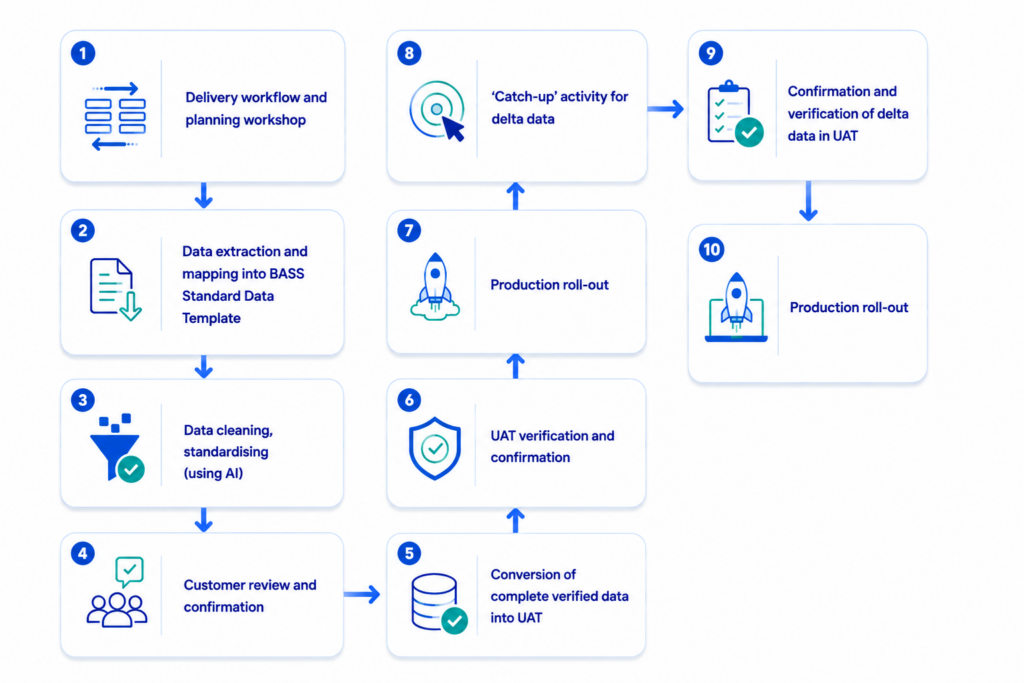
BASSnet PMS Data Migration Process Flow
The BASSnet team has extensive experience migrating and converting PMS data from various third-party systems. We also bring over historical job data, and review and perform data cleaning and standardisation for centralised fleet management.
With an end-to-end data migration framework, the transition is managed smoothly, securely, and with minimal disruption. Here’s how it works:
- Migration Planning Workshop
Every migration begins with a requirement briefing and planning workshop. Together with your team, BASS defines the scope, delivery workflow, and timeline. This step aligns expectations and ensures all stakeholders are clear on objectives and deliverables.
- Data Extraction and Mapping
BASS extracts data from your current Planned Maintenance System (PMS) or other third-party databases into a standardised BASS template. Our experts review, analyse, and perform data mapping to ensure that every important record is properly converted and migrated into BASSnet, avoiding any data loss.
- Data Cleaning and Transformation
We’re highly experienced in transforming data from manual systems, including Excel and PDF formats. Information is extracted, reviewed, and cleaned before being loaded into BASSnet to ensure the highest level of accuracy and consistency. We also leverage AI for smarter, more efficient and more accurate data cleaning and transformation, as well as data extraction from manuals.
With good quality PMS data, the customer can also leverage on AI solutions to drive better decision making, cost savings, and efficiency.
- Data Conversion and Delivery
The cleaned and mapped data is converted into the BASSnet database format. Once completed, BASS delivers the vessel database (DB) along with a comprehensive delivery report for full transparency.
- User Acceptance Testing (UAT)
Next, the vessel DB is uploaded to the UAT server, where your team performs verification and confirms the data’s accuracy and completeness. BASSnet specialists work closely with you to address any findings promptly and efficiently.
- Production Roll-Out and Go-Live
After UAT approval, BASS uploads the verified database to the production server, marking the system go-live. The final delivery report is provided for record-keeping and audit purposes — ensuring full confidence in your operational data.
Unlocking AI-Driven Value with High-Quality PMS Data
The value of high-quality PMS data extends beyond successful data migration; it serves as a key enabler for smarter AI-driven strategies that build on:
- Clean, structured, and standardised PMS data that enhance planned maintenance processes and improve visibility across fleet operations.
- Consistent and well-linked datasets for functional assets, jobs, and spare parts.
At BASS, for example, the approach to data migration and data cleaning ensures that PMS data is not only accurate but also structured and standardised for advanced use. Additional data population services further strengthen data completeness and reliability.
With improved PMS data visibility and accessibility, customers can better leverage AI tools—whether within BASSnet or through third party and in-house solutions—to support maintenance planning, optimise workflows, and drive continuous operational improvements.
High-quality PMS data, when leveraged through AI solutions, is the key to enable faster and more informed decisions and fleet-wide cost savings.
Beyond Migration: Extended Data Management Services
Your ERP software provider should also offer more than basic migration for a successful roll-out. At BASSnet, our database management and vessel PMS and fleet database building services extend the value of your investment for better fleet-wide data control and reliability.
- We support the upload of various licensed consumable digital catalogues, such as IMPA, into BASSnet. To ensure smooth project coordination and delivery, dedicated personnel are assigned throughout each project and the post-delivery period.
- Frequent progress meetings are conducted to keep stakeholders informed at every stage.
- At BASS, quality is built into the process. Each stage of migration includes documented checks, validation reports, and direct customer communication. This collaborative approach ensures that your operational data—the foundation of your fleet’s performance—stays complete, consistent, and compliant.
Set Sail with Confidence in Your Fleet Data
More than a technical exercise, maritime PMS data migration is a business-critical initiative. It’s the significant first step toward enhancing your fleet management experience. Secure a trusted partner who ensures your data arrives safely, structured, and ready for success in the new maritime digital era.
Learn more about how BASSnet can streamline your fleet data migration and database management today.